


Businesses must register as regular taxable persons under the Goods and Services Tax (GST) if their annual revenue exceeds the threshold limit of Rs. 40 lakhs (in case of goods), Rs. 20 lakhs (in case of services), or Rs. 10 lakhs, as applicable. GST registration is the term for it.
It is mandatory to generate the GSTIN if annual turnover exceeds the above prescribed limit. If the company conducts business without registering for GST, it is an offence and faces severe penalties.
It typically takes 4 to 6 working days to register for GST. In 3 simple steps, Team Online Legal India can assist you in obtaining GST registration more quickly.
Regular, sporadic, non-resident and e-Commerce operators are some of the different GST registration categories. Casual taxpayers, non-resident taxpayers, and e-Commerce enterprises must register for GST regardless of the turnover criteria.
According to the GST Act, a casual taxable person is a person who sporadically offers goods or services in a State or a Union territory where the firm doesn't have a fixed location. Individuals running roaming businesses at shows or seasonal operations would so be regarded as casual taxable people under the GST.
A non-resident taxable person is any person, corporation, or organisation that offers goods or services subject to the GST but does not have a permanent place of business or habitation in India (NRI). Because of this, any foreign person, business, or organisation that provides goods or services to India would be regarded as a non-resident taxable person and would have to follow all applicable GST legislation in India.
An "electronic commerce operator" is somebody who owns, operates, or oversees a digital or electronic facility or platform for electronic commerce. Anyone who sells online can be categorised as an e-Commerce Operator and is consequently needed to register for GST, regardless of the amount of business earnings.
PAN of the Applicant(Proprietor)
Aadhaar card
Proof of business registration or Incorporation certificate
Identity and Address proof of Promoters/Director with Photographs
Address proof of the place of business
Bank Account statement/Cancelled cheque
Letter of Authorization/Board Resolution for Authorized Signatory
Rent Agreement in case the PPOB(Principal Place of Business) is rented
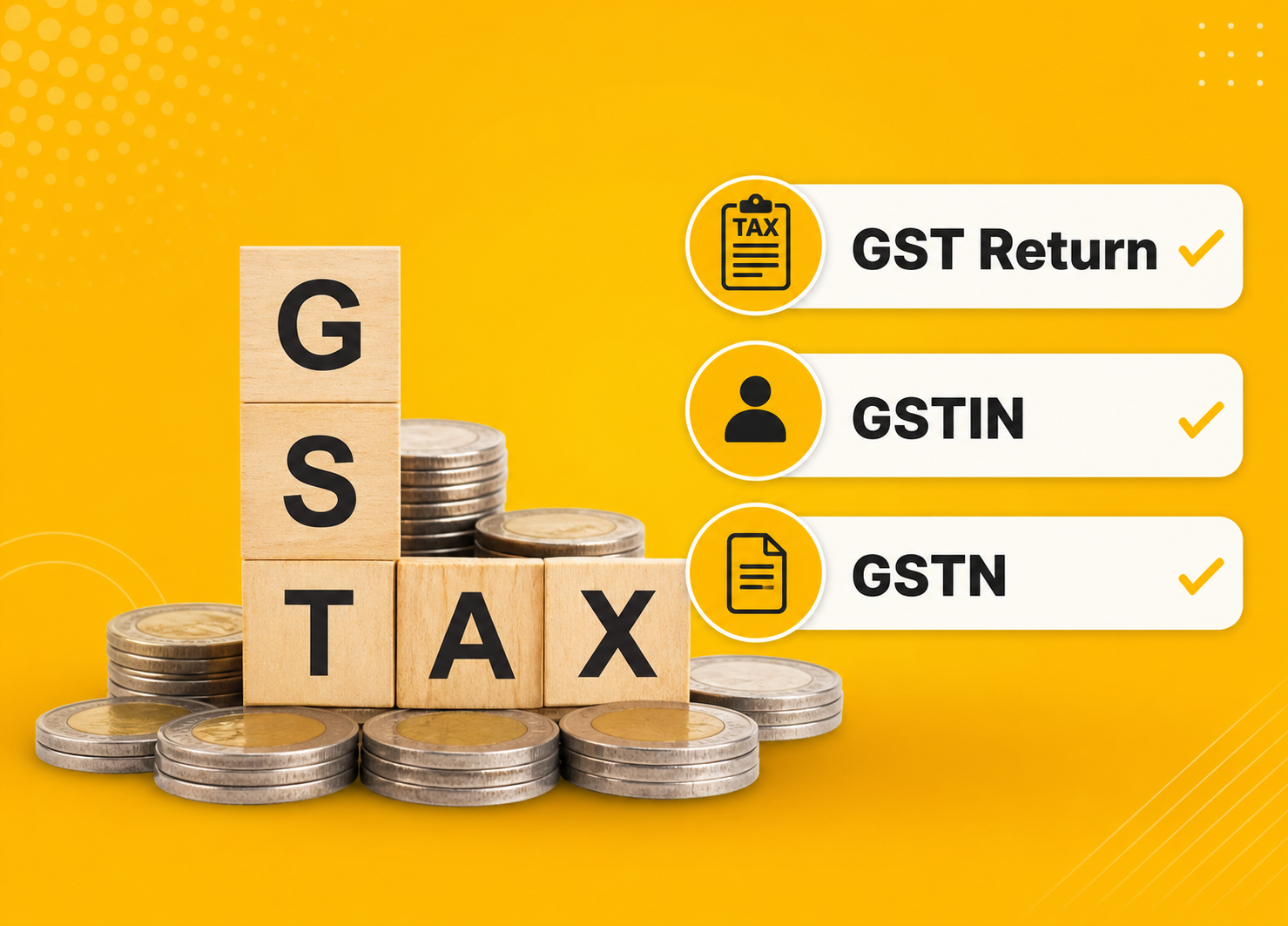
A GST return is a record of income that must be submitted to the tax authorities in accordance with the legislation. A taxpayer is required by the GST law to submit two GST returns, either monthly/quarterly and one return each year (if applicable). All tax returns must be submitted electronically. Please be aware that there is no option to avoid return filing. All unreported invoices for the prior tax period must be included in the current month. A registered dealer is required under the GST to submit returns for purchases, sales, output, GST (On Sales), and input tax credit (GST paid on purchases).
Each GST taxpayer receives a different identification number or GSTIN. Anyone with a GST number can access the GST portal to validate a GSTIN number.
The Goods and Service Tax Network (GSTN) is a section 8 (non-profit) private limited business that operates outside of government. GSTN serves as a one-stop shop for all of your indirect tax needs. To assist you in preparing, filing, amending returns and paying your indirect tax bills, GSTN is in charge of managing the Indirect Taxation platform for GST.

The GST has integrated the Indian market by bringing together several indirect taxes under a single roof.
The cascading impact of numerous taxes and VATs was eliminated by implementing GST, which decreased the cost of goods and services.
Small businesses benefit from GST registration since it lets them avoid time-consuming tax services. Since service providers and product suppliers with annual sales of under 20 lakh rupees and 40 lakh rupees, respectively, are exempt from paying the GST.
The GST was implemented with the intention of eliminating fraud and un-receipted sales. Additionally, it assists in lowering the amount of indirect taxes that small businesses must pay.
GST registration provides for centralised registration and brings uniformity to the taxation process. This makes it easier for businesses to submit their quarterly tax returns online.
Small businesses with revenue between up to Rs. 1.5 crores can gain from the GST because it offers the possibility to reduce taxes by using the Composition scheme. The tax and compliance burden for many small firms has decreased as a result of this action.
The lengthy 11-step procedure of registering for GST necessitates the submission of numerous business details and scanned documents. Although there are no fees specified by the GST law for self-register on the GST system, purchasing the GST registration plan with Online Legal India can save you a tonne of time and hassle. You can choose Online Legal India’s GST Registration services, where a GST Expert will help you with GST Registration from beginning to end.
A penalty of 10% of the tax amount owed, subject to a minimum of Rs. 10,000, must be paid by the violator who fails to pay taxes or makes short payments (sincere errors).
When the offender has purposefully avoided paying taxes, the penalty is 100% of the amount owed.


Online Legal India provided a transparent pricing structure with no hidden charges. The team explained the entire process before beginning, and I could track the status of my GST registration online. It was a completely stress-free experience. Will definitely use their services again!
As a small business owner, I was confused about GST requirements. Online Legal India not only completed my registration but also educated me about compliance and return filing. Their step-by-step guidance was a big relief. Great service for entrepreneurs!
I found Online Legal India through a Google search and decided to give it a try. To my surprise, the process was incredibly quick. I uploaded my documents online, and the rest was handled efficiently. Kudos to the team for delivering what they promise!



GST or Goods and Service Tax is a kind of indirect tax for India and applicable on the supply of products and providing of services. It is a comprehensive and multi-staged assessing; comprehensive because it has subsumed all the indirect taxes except a few and multistage because it is implicated at every step within the generation prepare. It is supposed to be discounted to all the parties within various stages of generation except the ultimate consumer.
